
038: A Surfer Who Only Knows Feeling - MATT FORMSTON - 2X Adaptive Surfing World Champ
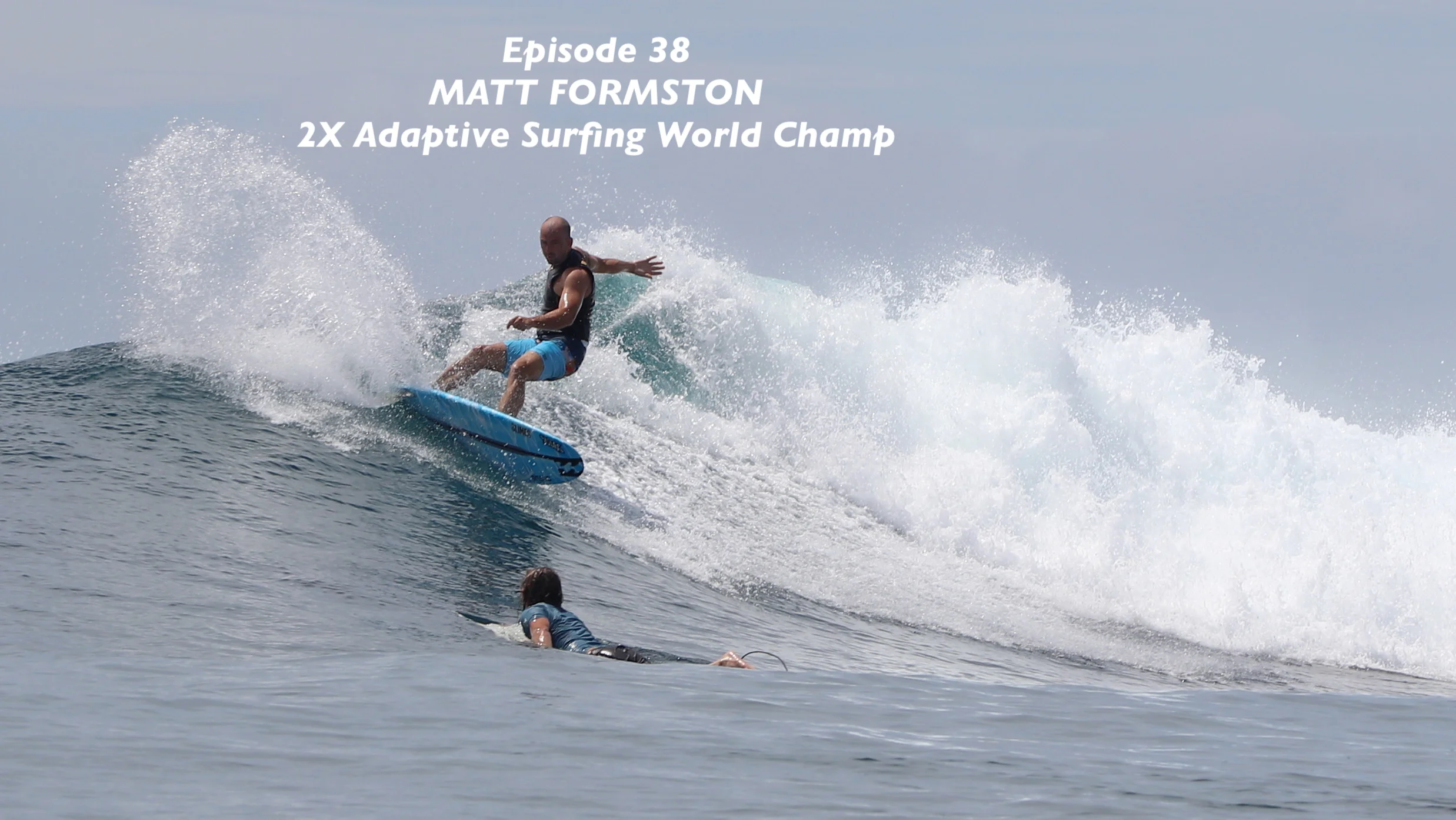
SHOW NOTES:
Can you become a world champion surfer without being able to see the wave you’re riding?
Many surfers struggle to progress, constantly seeking better technique, gear, or coaching—while neglecting the most powerful tool they already have: feel. Matt Formston, a blind surfer and 2x world champion, shares how his lack of vision forced him to master presence, wave reading, and intuition on a level most surfers never reach.
Discover why “listening” to the wave can be more powerful than watching it
Learn how to tap into feel, proprioception, and flow—even if you’re fully sighted
Hear how Matt turns perceived limitations into competitive advantages at the highest level
Press play now to transform how you approach surfing—from your feet to your mindset—with Matt’s radically insightful perspective.
Matt goes into detail of the feeling of surfing, the challenges and rewards of surfing blind.
http://mattformston.com
http://malibupopoyo.com/events/
https://thebeachbox.surf
https://www.linkedin.com/in/samba-mann-54210164/

Key Points
Matt Formston, a visually impaired world champion surfer, explains his level of blindness and how he navigates while surfing
Matt describes how he uses sound and wave patterns to paddle out and catch waves without vision
Matt discusses how his disability forces him to be more present and focused on feeling the current wave section rather than looking ahead
Matt explains how coaching has transformed his surfing through verbal feedback and in-water guidance despite not being able to see video footage
Matt shares insights from his cycling career about staying relaxed under pressure and applying that mindset to competitive surfing
Matt discusses his equipment preferences, particularly favoring shorter boards for better wave feel and connection
Outline
Matt Formston's Visual Impairment
Matt Formston is almost completely blind, with no central vision and only about 5% peripheral vision.
They describe their vision as seeing blurry shapes and lines with some contrast sensitivity on the outer edges of their visual field.
This level of visual impairment presents unique challenges for surfing, which is traditionally considered a highly visual sport.
Surfing Techniques for the Visually Impaired
Matt has developed specialized techniques to surf despite their visual impairment.
They rely heavily on their other senses, particularly proprioception and hearing.
When paddling out, Matt listens to the sound of approaching whitewash and uses the wave patterns to time their movements.
They feel the water sucking as a wave approaches to know when to duck dive.
While waiting for waves, Matt senses the changing intervals and steepness of the swells to anticipate incoming sets.
They prefer to sit in the critical section where the wave breaks, allowing them to take off at the last moment under the lip.
Matt emphasizes that all surfers use feel to some degree, but they have honed this skill out of necessity.
Matt's Surfing Background and Motivation
Growing up in Narrabeen on Sydney's northern beaches, Matt was introduced to surfing as a child through bodyboarding.
They transitioned to stand-up surfing similarly to many sighted surfers.
Matt is driven to continually improve their surfing primarily for the enjoyment it brings.
They believe that as their skills improve and they can perform more critical maneuvers, surfing becomes increasingly fun.
This pursuit of enjoyment through skill development is Matt's main motivation for competing and striving to be a world champion adaptive surfer.
Reactions to Matt's Surfing Abilities
People are often shocked to learn that Matt surfs despite being blind.
Even after witnessing their competent surfing, many struggle to comprehend how they manage it.
Matt explains their techniques by comparing them to surfing in the dark, an experience many surfers can relate to.
They emphasize that they use the same senses other surfers rely on in low-light conditions, but they have refined these skills through years of practice.
Heightened Sensory Awareness in Surfing
Matt's blindness forces them to be hyper-aware of their other senses while surfing.
This heightened awareness allows them to feel subtle changes in the wave's energy, the board's movement, and their body position.
The interviewer experienced a taste of this heightened awareness by surfing with vision-impairing goggles, noting increased sensitivity to the feel of the water, board, and wave energy.
This experience suggests that sighted surfers might benefit from occasionally closing their eyes while surfing to develop a deeper connection with the wave and improve their overall performance.
Competitive Surfing and Coaching
Matt has achieved success in competitive adaptive surfing, winning world championships in their division.
They work with a coach, Sam, to refine their techniques and improve their performance.
Their coaching sessions involve unique methods, such as Sam riding behind Matt during a wave to provide real-time guidance on upcoming sections and maneuvers.
Video analysis is also used, with Sam describing the footage in detail to help Matt understand and correct their technique.
This coaching has significantly improved Matt's surfing abilities.
Mental Approach to Surfing and Competition
Drawing from their experience as a world-champion cyclist, Matt has developed a calm, focused approach to competitive surfing.
They emphasize the importance of relaxation and being present in the moment, rather than getting overly excited or stressed before a heat.
Matt visualizes success and focuses on controlling the variables they can influence, such as equipment choice and preparation.
They credit this mental approach with helping them perform at their best under pressure.
Equipment Preferences
Matt's favorite surfboards include the Slater Designs Gamma for good waves and the Firewire Termo Evo for smaller conditions.
They prefer shorter boards, feeling they allow for a more immediate connection with the wave and quicker decision-making due to the reduced distance between their front foot and the nose of the board.
Spiritual Connection to Surfing
Matt describes a spiritual aspect to surfing, particularly when riding clean, glassy waves.
They feel a deep connection to the earth and the ocean, comparing it to the grounding effect of standing barefoot on sand.
This connection is strongest when they can maintain a smooth, uninterrupted ride along the wave face.
Advice for Surfers with Disabilities
Matt encourages surfers with disabilities to commit fully to their surfing, avoiding hesitation which can lead to wipeouts or injuries.
They recommend starting in comfortable conditions and gradually progressing.
Matt also emphasizes the importance of acknowledging one's differences and being willing to ask for help when needed, noting that this openness can lead to more support and better experiences in the water.
Time Management and Life Balance
Matt stresses the importance of effective time management in balancing their surfing career with their corporate job and family life.
They compartmentalize different aspects of their life, focusing fully on each activity without distractions.
This approach allows them to maximize their performance and enjoyment in all areas of their life, including surfing.
Future Goals and Pushing Limits
Looking ahead, Matt aims to push their limits in big wave surfing over the next few years.
They are curious to discover their threshold for wave size and are committed to building their skills progressively.
Matt acknowledges that achieving these goals will depend on opportunities and support from others, as their blindness presents unique challenges in accessing and surfing larger waves safely.
Transcription
Matt Formston
The wave will tell you what's going on. I get more scared crossing a road than I do surfing an 8-foot wave. I think sometimes a disability gives you an opportunity because it takes away distractions. So I can't see the next section or the section ahead of that. I can only feel what I'm doing right now. So I just focus on that and then hope that I get another section. That's.
Michael Frampton
A couple of quotes from today's interview, which is with Matt Formston, one of the world's best visually impaired surfers. In fact, two times world champion. But before I intro Matt and get into the interview, a couple of quick housekeeping items. As you've noticed, the podcast has been a little sporadic recently. So I myself am in need of some inspiration. So please, let's have some more listener feedback, questions, topic suggestions, guest suggestions. Mike at surfmastery.com. More listeners, more downloads will help me to get bigger guests. So please share with a friend and rate and review on iTunes. It helps a lot. The surf coaching trip with Matt Griggs and Taylor Knox is coming up in September. There's been quite a few listeners who have expressed keen interest, but very few of you have followed through. Now is the time to book this in, to lock it in. Put your money where your mouth is. Let's go surfing. I've already booked my tickets. I'm going. This is a once in a lifetime trip. Come and join us. Go to malibupapoyo.com to the events tab. Or if you have questions, you can email me as well, mike at surfmastery.com. A cool new product just got funded on Kickstarter actually. It's called Beach Box. It's a storage box. You can store your wet gear, dry gear, and has like a shower pump as well. Pretty cool product. Go and check that out at thebeachbox.surf. I will put links in the show notes to all of these websites. Only a surfer knows the feeling. Such a cliche, because it's true. But this surfer only knows feeling. He surfs by feeling. His name is Matt Formston, and two years in a row he's been crowned world champ in his division at the ISA Adaptive Surfing World Champs. Matt is a world champion tandem cyclist. And yes, Matt is pretty much completely blind. And here is my conversation with Matt.
Michael Frampton
Are you like blind as a bat? I mean, how blind are you?
Matt Formston
I've got, no, I'm totally blind in my central vision. So if you know what tunnel vision is, I've got the opposite of that. And so the way I explain it to people is if you put your hands, if you put two fists together and put your hands up in front of your eyes, which will block out all of your central vision, and then if you imagine the body, so then you can still see 100% on the outsides, right? You can still see full clarity of what's on the outside of your fist. If that was a piece of Perspex and you took sandpaper and blurred that out until 95% of the clarity was gone from what you see on the outsides, that's what I see. So nothing in the middle and about 5% on the outside. So it's basically shapes and lines. I can see a bit of contrast and your lines.
Michael Frampton
Okay, so most people would associate surfing with quite a visual sport. So, I mean, how do you surf? I mean, how do you even paddle out?
Matt Formston
Yeah, so most people associate it with vision. Most people associate most things with vision because it's the predominant sense they rely on. But then listening to a few of your podcasts, pretty much all of your guests talk about feeling the waves. So all surfers use feel. They just probably not dial into it as much. Paddling out for me is sound. So I listen to the whitewash coming towards me. So it's a combination of sound, patterns as well. Everything in my life is a lot of patterns. So I map my environment and then I use that information to navigate. So with paddling out, the map is the cadence of the waves. So I know if it's an 8-second period or a 12-second period, you get in sync with, okay, a wave's just gone and then another wave's going to come in 8 seconds. I'm not counting those seconds, but I just feel my body's tuned into the fact that there's a certain period between each set of whitewater. And then I'm using the sound of hearing the whitewater coming towards me. And then as it gets close enough that I sort of know it's imminent, I'm getting ready to duck down, I'm getting my speed towards the wave. And then I feel the wave suck because obviously the water in front of the wave sucks to become part of the wave because the wave is just energy moving. The physical water's not moving across hundreds of meters. It's different particles of water that are just energy that are moving. So the water sucks as you feel as you duck down, you can feel it suck you under. So as it starts sucking, I duck down and that pulls me through the back of the wave. And it's the same process over and over. Okay.
Michael Frampton
So is it sound or proprioception is your main sense when you're surfing? Which one?
Matt Formston
Proprioception.
Michael Frampton
Okay. So you're really acutely aware of the way the water's moving, how much up and down, sort of the intervals of the wave, that sort of thing, yeah?
Matt Formston
Yeah. So obviously I just explained paddling out. When I'm waiting for a wave, it's going up and down. And once again, it's the pattern. So it's feeling that I'm going up and down, there's a certain period. As the set's coming, the period changes because a bigger wave, generally there'll be a longer period. So if the small wave's over a 10-second period, you might blow out to 11 or 12 seconds, which is not a—I'm not actually counting the seconds once again, but I'm just tuning to the fact that the drop, as I drop into the trough, is a little bit longer and it's a bit steeper because the next wave is going to be bigger. It needs more space at the bottom of the wave to create that gap for it to be a bigger wave. So I'll drop steeper down into the trough. It'll take a bit longer. And then as the set starts coming in, I can feel that I'm going up steeper because it's a bigger wave, so there's a steeper incline. So that's when I'll start paddling as I'm in the trough of the wave. So my preference when I'm sitting at the back is to sit right in the critical section where the wave's going to break and take off under the lip because I can just start paddling at the last minute and then just take off with the lip as the wave's breaking.
Michael Frampton
So how did you get into surfing anyway?
Matt Formston
I grew up in Narrowbeen. Most kids growing up in Narrowbeen on the northern beaches of Sydney learned to surf. I lived on the lake, so I just used to paddle around. My brother was a surfer, and my dad used to just basically take me out on a bodyboard, similar to most little kids. Different to them, he would push me into waves, and obviously you start going straight, then you learn to turn across the wave and go across the face. So I learned how to feel waves on a bodyboard and then just transitioned from the bodyboard to a surfboard, which is probably a pretty similar process to a lot of guys that surf, a lot of girls that surf.
Michael Frampton
And what drives you to be a world champion surfer?
Matt Formston
Fun, really. We had this conversation earlier before we did the podcast. The drive for me is to have fun, and I talk to a lot of people about this when I'm saying maybe you should get bored, so you got equipment and those sorts of things. The better you are at surfing, the more fun you're having. The more critical maneuvers you can do, the more you can stay in the pocket, the more surfing becomes fun. If you're just trimming and doing a high line, that's fun, but if you're able to rip a turn back into the pocket and stay in that section, that's more fun, I think. So for me, as I get better and better at surfing, I'm having more fun, and that's my driver, is to become a better surfer, to have more fun.
Michael Frampton
What sort of, when people learn that you're, because it's not obvious that you're blind, because you don't have white pupils or anything, so when people kind of discover that you're blind, what are their usual reactions they see you in the water surfing?
Matt Formston
When Well, surfing, people freak out. They're like, but how do you surf? It's the most straightaway, how do you surf? It's like, well, for some people, I've been out there surfing with them for an hour, and I'm probably catching as much or more waves than most guys when I'm out, because I sit right in the critical section. I don't catch the best waves, but I catch a lot of waves. So they would have seen me surfing, and I'm okay at surfing. I can hold my own in the water. But then they still have a mental block. They've probably seen me surfing, seen that I'm confident in the water, but as soon as they find out I'm blind, they're like, but how do you surf? And their brain can't get around the fact that I'm blind and I'm a surfer. So I can explain to people pretty quickly, like I have a little bit here, around how I surf. The quickest way for me to explain it to a surfer is, have you surfed in the dark? And most surfers have been out, when it's good, it's pumping in the afternoon, and the sun goes down and you push it a little bit and stay out past dark. And you're then in that situation where you're relying on feel and sound and all those senses that I use on a daily basis. And most people that have done that the day after, they're like, it was really cool, I was just feeling the wave, I had to feel the wave. So all surfers will do that at some point, they rely on this, on feel and sound, when they've been out at night. I just do it every day, I've been doing it like that for 30 years.
Michael Frampton
Yeah, a lot of my previous guests have spoken a lot about the feeling of being connected to the wave. And we just went for a surf, where did we go?
Matt Formston
Terrigal Point.
Michael Frampton
Yeah, and there's sort of, you know, overhead, sort of what we would call four foot in Australia sets coming through and quite chunky and wobbly. And you gave me a pair of goggles to wear. Which kind of simulate what you see, which is not much all.
Matt Formston
At Well, it's everything for me.
Michael Frampton
Yes, for you it is. For me, it was very daunting. I was too scared to put them on to paddle into a wave, just because I didn't know the break and it was so messy. So I had them on my forehead and then once I was up on a wave, there's three or four waves, once I kind of got in rhythm, I put the goggles on to get a sense of what you might be experiencing. And as soon as I put the goggles on, I was hyper aware of my other senses. Yeah. Something I've never experienced before. I started feeling the speed of the water running under my board. My board felt like more part of me than it's ever felt before. Yeah. I felt I was more in the moment. I almost felt like I was surfing big waves, like I was more focused, because I had to be. And then I caught a couple of waves, I took the goggles off and then caught a couple of waves with my full vision as usual. But I took some of that hyper body and water awareness into those next few waves and combining that with my vision, surfing just felt so different for me. Okay.
Matt Formston
And why?
Michael Frampton
Just I felt my feet felt bigger. Yeah. I felt the wave more. I guess that hyper awareness of the feeling of the wave, it almost feels like surfing was 95% visual for me. Yeah. And then when I put those goggles on, it was less than 5% visual. So it just made everything else, like the wind passing by your face, the feeling of the water, all of those things became more important. My brain instantly became more aware of that. And then so essentially after that, on my next waves when I had my vision, my brain still remembered what everything else kind of felt like. I mean, to put it simply, surfing became, I became more immersed in surfing. Yeah. I think I got more out of those last couple of waves than almost any other wave I've surfed. Like I think it was a very profound experience for me. And it's sort of, a lot of my other guests have spoken about the feel of this, you know, feeling the board and feeling connected to the wave. And I think maybe that's what, that's part of what separates them from other surfers. I mean, a lot of them do have actually better vision. I've tested them and they do have better vision. But they just are more aware of their other senses as well. So, you know, if they're in a barrel and a chandelier comes across, they're not affected by it because they're aware of their other senses as well. Whereas most surfers, a chandelier comes in the barrel, they lose their vision, they're gone. Okay. Whereas good surfers, that doesn't affect them as much. And I think for the general public and the intermediate, average surfer looking to get better, I think we need to become more aware of our other senses.
Matt Formston
Yeah. So when we were out surfing today, we, the, because it was really windy today. It's like 30 knot on shores. It was cross shore where we were. But the waves were coming in and we were getting pushed off the reef. I'm a conscious, I was conscious that we moved off the reef because I could feel that as we were going up and down, the transition was more smoothed out. So as you're sitting on the reef, the waves peak more because they're trying to break. So it's more vertical. So you're going up and down. So I can feel myself going up and down steeper. It's the same swell, but it just, as you move off the reef and you guys can see it, it's more flattened out. It's more even. I, that particular, that's my, where we surf today is probably when it's big, that's my most, that's the place I go most of the time. So I know that place, like the back of it. I know everything it does. A lot of sighted guys, I'll move, I'll start paddling back in towards the reef and they're all still sitting there because they're relying on sight and markers on the shore and other things. And I'll end up getting, today was really tricky for me because it was chop and it was windy and so I can't use my hearing. A lot of my senses were taken away. The chop takes away, it makes it really difficult for me to feel the waves. So it's really tricky for me today. It was probably the trickiest it gets. But when it's clean and it's good, I can get myself right in the perfect spot because I'm feeling exactly where the wave wants to break. And I know when a set comes where it's going to want to break and I can take off right under the lip. Where sighted guys probably aren't tuned into that information as much and they end up in the wrong spot. Whereas good surfers, really good surfers, use the combination of sight and feel and they're sitting in the perfect spot and they know exactly, they know where to sit that they can, in between I might be sitting too far in, they might be sitting somewhere in the middle because they know that they can cover the ground from where I am where it wants to break if it's smaller to where it might break a bit further out if there's a big set coming through. So they're more tuned into the environment as to where it's going to break, where's the furthest in and where the furthest out it's going to break to be in that right spot so they'll get all the good waves.
Michael Frampton
When you do a bottom turn, how do you know whether the wave is about to barrel or flatten out?
Matt Formston
So as I come through and do my bottom turn, the first part of my bottom turn is pretty similar most of the time. As I come through, as my nose starts to come up the face, I can feel by how steep the wave is if it wants me to, if I go the first third of the wave, as you're coming to the first third, as you're going up that part of the wave, I can feel if it's really steep, I'm not going to be able to make it up for a turn, it wants to barrel, I need to then obviously turn back down the wave and then I can run my hand along the face, so if you're talking about barrelling, run my hand along the face and if I feel it's really steep at that section, then I'll sort of pull in and use the feel of where my hand is based on if it's right in front of me and it's coming close, if the wave's coming really close to me, I know that it's barrelling and it's going to go to the top of me, so I get down low and then try and get some speed, whereas if I come up to that third and it's standing up, so my nose is still pushing me up towards the top of the wave, but it doesn't quite feel like it's going to barrel, then I know I can go up and hit the lip and do sort of a vertical turn. And then when I get to that top of that turn, then based on how much energy is in the lip, so if it's trying to throw me, I know that I'm probably fairly deep in the section, I'm not right in the pocket, so I'll come back down pretty much straight and then try and make it round that section, whereas if it feels like the energy's petering off a bit and if I'm on a right-handed, for example, if the energy feels like when I turn it's tapering off a bit, then I'll complete that turn and then do a bottom turn and come back up again and it's the same process again. Whereas if I come up, so we'll go back, this is the third scenario, there's multiple scenarios, but these are the three most defined scenarios. In that first third of the wave, if I come up and it's not very steep, then I know that if I go and do a vertical turn, I'm going to wash off all my speed, there's not going to be enough power in the wave to push me out of that section, so what you guys would go to do, everyone would go to do a cutback, but I use that first third of the wave as my nose comes up to know that I'll project out in front of the wave and do a cutback because it's going to be flatter. Then as I get to the next third, I get more information from that second third and then the top third of the wave is where I do my maneuver. I'm getting information from each third of the wave as I transition up the wave based on what my board's doing.
Michael Frampton
It's almost like you're forced to be closer to the present moment than visual people, because visual people are always just looking down the line. So you've got to make faster decisions based on the feeling and the sound. Yeah. Do you have any techniques or strategies to bring yourself into the present moment more, to focus more, to be in the zone?
Matt Formston
I think I naturally just fit in the zone. I've done a number of sports and I've always found myself that I can really focus on the job at hand. My techniques are probably along the lines of most other people that are tuned in is just, why would you be thinking about anything else? If that's what you're doing right then, there shouldn't be really any distractions. I suppose that I don't get distracted from the next section because I can't see it. I talk a lot about opportunities and I think sometimes a disability gives you an opportunity because it takes away distractions. So I can't see the next section or the section ahead of that. I can only feel what I'm doing right now. So I just focus on that and then hope that I get another section.
Michael Frampton
Do you ever find yourself lost in thought and losing that present time awareness?
Matt Formston
Yeah. So I don't really find myself. I find sometimes that if I'm really stressed, if there's multiple things going on in my life, I can get distracted because I'm trying to do too many things at once. So the technique that I use a lot, and this is more for time management because I've got quite a senior corporate job. I then try and surf three or four hours a day. I've got a two-year-old and a four-year-old. I've got another child coming this year. My main focus in my life is my family. So those other things come behind my family. But I need to spend time with them and obviously to be able to surf well, I need to spend a lot of time on the water and to be able to get my corporate job, there's a lot of time for that as well. So time management-wise, I always, when I'm with my family. I don't answer my phone. When I'm working and I don't get distracted from that. And when I'm surfing and I don't get distracted from that. So I just try and be really focused on what I'm doing at the time. I know there's multiple things going on in my life and potentially stresses and stuff going on, but for me, if I just focus on what I'm doing right then, I do it well. And that way there's no rework, if you like. I don't have to go back and do things. I'm not making mistakes. I'm getting things right at the time. Especially with surfing, if I'm really focused on that session. For me, I can't really, we work on my coaching. I work with a coach, we speak, Samba, we speak a couple of times a week, but we can talk about particular maneuvers, but I can't really pick a section to go and do that maneuver on, like a sighted person would, because I don't know what's coming up next. So if an opportunity, I'll do certain moves and I'll do them better because we work on that move, but I can't go out and say, I'm going to just do this move and find a section to do that move on because I'm feeling every wave and I feel like the wave determines for me and how I feel the wave determines what maneuvers I do. So what I was talking about before with coming up that first section of the wave and how steep it is, if there was another section 10 meters down that might be better to hit with more speed, a sighted person could see that and run for that section. I don't have that opportunity, so I'd go high and end up coming down underneath that section. So I'm always in the present moment. So I can work on those parts of my surfing and make those maneuvers better, but it can only happen when the opportunity presents itself.
Michael Frampton
So time management and life management is key to being present.
Matt Formston
Definitely. If you've got multiple things happening, and in day life that's the reality for pretty much everybody, and you let them bleed over into each other, you're always, you think about too many things and then you're distracted. Whereas if you can silo things and really keep them segmented, then you can enjoy your fun stuff, you can take the serious stuff serious, and you can, the joy that you get with your family and your loved ones, you can really just let everything down and just chill out and let that settle in as well.
Michael Frampton
When did you learn or discover the importance of time management?
Matt Formston
It wasn't probably until my late 20s. I was definitely not good at time management when I was younger, and I would get stressed quite a bit. At school I was always doing my, I was the person doing my exam the night before, and I think it was as I became more senior in my role at work and I was trying to take on more projects outside of work and running a business and just doing multiple things, there was just a necessity for me to have that time management, otherwise things just didn't work. So it was, I think like a lot of things in my life, it was more of the fact that it came from necessity. And then it's building blocks, like as you, it's like surfing, when you first start surfing, a two foot close out can be quite confronting. And as you surf more and more, all of a sudden a six foot wave is playful, you can play with it. If it's the right conditions, and you just build. And time management or any other skill in life is the same, as you get better at something, you can put that in the bank and go, okay, I'm going to accelerate that now and get better. So you, for me everything in life is about, okay, well this is now my baseline, how can I get better at that? And just finding little ways to tweak anything in your life to make it a little bit better. So you're never going backwards and I try and stretch myself as well, so I don't really believe in taking little steps, I always have big goals. So I got back from the Paralympics from cycling in 2016, and I went, okay, I want to become a world champion in surfing, which has always been my love and I've always surfed, but I've never had that opportunity because world championships for adaptive surfing just didn't exist until 2016 in my category. So I had that opportunity and wanted to take it on. So I mean other people might go, I'd like to get on the Australian team, or I'd like to have a, they get a small goal. For me it's just, why not go for the top, and if you fail and you don't quite get there. Then you're probably going to end up somewhere in between. Whereas if you go and have a small goal and you get there, it's going to take you so long to get to the actual goal where you want to get. You might have to just go straight for the big goal, and then within your time frame, and if by the end of that time frame you haven't got there, you work on the stepping stones to get there within your next time frame.
Michael Frampton
Okay. So think big. Yeah.
Matt Formston
World records are a thing of the past.
Michael Frampton
How do you mean?
Matt Formston
So people get mentally fixated on the minute mile and all these sorts of mental blocks, and then everyone else, so they might sit there, a world record, while I sit there for three or four years, and then I'll just get blown out of the water because someone comes up, one person will come up with an efficiency, or they'll train a bit harder, or make technological gains that blow that world record out of the water. But people in their head think that's a mental barrier. They don't think it's a mental barrier, but it is because they look at that as the fastest a human can go. The way I like to look at things is, well, that's the fastest a human has been, so that's the baseline. How fast can I go? Or how big can I go? Or, I mean, if you look at that, that's the baseline. So you look at that, for me, that's the starting line. How did that person get there? And you work towards that, which is the world record, and then you get efficiencies beyond that. That's the psychology I look at things from. Whereas I find when I talk to a lot of people, they have a psychology of saying yeah, but that's the world record. How about I go for something a lot less? And I just think you're cutting yourself short by doing that.
Michael Frampton
So what's the biggest wave you've ever surfed?
Matt Formston
It's probably, I've surfed 12 foot surf a number of times, but probably 15 foot.
Michael Frampton
By the way, that's Australian. Australian, so that's like triple overhead.
Matt Formston
Yeah.
Michael Frampton
Yeah, that's pretty solid.
Matt Formston
A bit over triple overhead, yeah.
Michael Frampton
Did you get, like, how? Like, like, there's a lot, I've surfed triple overhead and there's a lot going on.
Matt Formston
Do you get scared? Yeah.
Michael Frampton
You've got heavy boards, heavy water.
Matt Formston
Yeah, but what's, so when it's big, it's the gap between what you do and what I do diminishes significantly. So in a small wave, the transition from the top to the bottom, that third that I was talking about, is only, in, say, let's say a three foot wave, that's one foot. So my brain has to make those decisions within one foot of what I'm going to do at the top of the wave. When it's a double overhead wave, all of a sudden that third of the wave is a metre and a half. So you time.
Michael Frampton
Feel like you've got more.
Matt Formston
I've got more time to do things. I've got more time to get down the line. I've got more speed as well. The wave will generate the speed. I don't have to generate the speed myself. As much as you do in a small wave. So I find big waves easier to surf. We talk about fear. I'm a lot more, I get more scared crossing a road than I do surfing an eight foot wave, a double overhead wave. Because the cars these days are silent and I can't see the cars and I use this. So there's so many more things in my life that I'm more scared of than surfing. If I come off, like, if I get a hold down in a big wave, I'm underwater for a bit of time, it's the same as you. Same as anybody. Yeah, so I don't really get, my mates say as well, like where we were surfing today, we're taking off with rocks in front of us. We were seeing a bit wide, but normally you would take off right off and when you're taking off there's rocks right in front of you. And there's rocks in the face sometimes. And when it's big, my mates are like, mate, if you could see the rocks right there, you'd be scared, but I can't see the rocks. So once again, that's another benefit for me is that I can't see some of the things that could be dangerous. So I just go, I just charge and just enjoy it. And I'm not distracted by the obstacles that sighted people might be distracted by.
Michael Frampton
Yeah. Yeah, I suppose, I mean, it's one big thing when you do surf big waves. Often when you're paddling in, you can't see anyway. Yeah. But you're used to that.
Matt Formston
Yeah. Yeah. So another good example is, we were sitting there, so we sat down on the boat and we were looking at that break. It doesn't break where we surf today, because it's sort of five foot plus. The guys will sit there and you can hear in their voice what they're talking when it's big, they're like, it's pretty solid. And in their voice, you can hear they're a little bit stressed because it's big. Whereas I'm sitting in the car next to them going, cool, it's big, that sounds like fun. I can't see it. So they're looking at that, and before they do a 10-minute paddle to get out, and that whole time in their psychology is like, wow, it's a bit big today, it's heavy, whatever. In my head, I can't see how big it is. I can hear it, that there's energy, but I don't have that visual stimulus that gets the people's heart rates up and gets them a little bit stressed. Because that anticipation of the fact that it's big and it might be a bit heavy, I think, gets in people's way as well. Whereas I don't have all that. I just get out the back and I'm just excited that I'm out there, and I'll get to surf some of those waves. And then when I actually find out how big it is when I've done my bottom turn. That's the first time for me when I go, wow, cool, here I've just dropped down to double my body height, and I'm flying, and by that point, I'm just loving it. But it's when I finish that wave that I go, cool, it's pretty big today.
Michael Frampton
So again, that comes back to just being present. It.
Matt Formston
Does. Yeah. But for me, the opportunity is that I don't have any choice. Yeah. I mean, I could, I mean, other people have the psychology of listening to someone saying, well, it's pretty big today, and go, wow, that's scary, I don't want to get out there because I can't see. And if it's scary for a sighted person, then it should be even more scary for me as a blind person. But I don't have that psychology.
Michael Frampton
Interesting, yeah. Because you say it's a choice.
Matt Formston
Everything in life is a—everything in life is a choice.
Michael Frampton
Choice. Whether you can see or not, it's still a choice.
Matt Formston
Like you.
Michael Frampton
Say, if the guy next to you can see that it's big, he makes the decision based on what he sees to be a little apprehensive.
Matt Formston
Yeah. And what he sees as his or her limitations as well.
Michael Frampton
Yeah. But if he tells you it's big, there's no fear. That doesn't bring, like, he sees the big surf and he gets a little apprehensive. You hear about the big surf, but you don't get apprehensive. How does that, where does that mindset come from?
Matt Formston
I think it goes back to talking about world records and that being a baseline. Right or wrong, I think if someone else has done something, I can probably do it too. We're all physically built from similar DNA. I'm a, like, I'm not, I've just had a shoulder reconstruction in December, so I'm being back in the water for 10 days after two months off, so right now I'm probably the fittest, unfittest I've ever been in my life. But generally I'm a pretty fit, a pretty strong guy. So me being fit and strong has nothing to do with my vision. That's something that I can control outside of the surf. So I know that I'm fit, I know that I'm strong, I know that my body can handle a bit of a beating. So there's no point for me to then beat myself up mentally and not enjoy the surf as much as I can. So I know that I'm going out, I know that other guys have surfed bigger surfs than that before. I know that I've physically done it before and I push, we took building blocks. So I keep pushing the limits. So I want to keep pushing the limits over the next couple of years and see how far we can push it.
Michael Frampton
Where does that come from? Like as a child, when did that mentality start, do you remember?
Matt Formston
I think I've always been competitive, but sort of the first thing that I can remember being competitive in was like climbing trees when you're sort of five years old. And all the kids in the street were climbing trees and I remember I'd always climb the highest and my mates, the same thing as the surfing, and the guy saying you can't see how big it is, you can't see the rocks, so that's a benefit. The kids would say in the street, you can't see the bottom, you can't see the ground, you can't see how far away the ground is. So I've always pushed myself to try and be, I suppose, the best at what I can be. And then I played rugby in a body competition and I found that I was good at it. And I just wanted to be, I have a very strong sense of team and not letting people down. So when it came to team sports, it was more about me being a, not being a liability for the team and being a, and knowing that I had a disability, I didn't want to be a liability so the team had to make up for me and therefore not be a strong team within the league. So if I did my job well, I knew that I wasn't, other people weren't having to make up for it. And then extended beyond that, because I was trying so hard to do it well, I then became quite a proficient player and ended up playing reps, which we talked about earlier. So I think it's just, in my solo sports, it's been about pushing myself and seeing how far I can go with things. And then in team sports, it was more about being a solid team member and helping the team to succeed.
Michael Frampton
But you, how was your schooling life? I mean, did you go to a normal school? Did you go to a special.
Matt Formston
School? I went to a normal school. My parents decided, and that was in the, I went through school in the 80s and that was not normal. I think I was one of the first kids to do that with a disability. So I think the thought back in those days was you have a, you're a bit different, chuck you in a school with all those other different people. So you'd, people with autism, hearing impairments, all sorts of stuff that probably don't mix that well as far as their learning level. We're all just chucked into a room together and say, you guys, this is your curriculum. My parents thought of that and didn't really think it fit. And I was already in, because I lost my vision when I was five. So I was already in a mainstream school. So they decided to put me through, send me through mainstream schooling. It has given me a lot of abilities. So a lot of the stuff that I do, so I worked in sales and big business for the last decade before I moved into my current role. And I sort of feel like I had a 20-year sales course because I was always teaching, selling to my teachers. Because I couldn't read any of the books, they'd print out my books in large print. But the print was never large enough for me to actually read it. So I'd have these big books I had to drag around everywhere, which made me, I think it made me physically strong because I was carrying literally kilos of paper around that I couldn't use. Like at one point it knocked me out. I was riding my skateboard, I hit a rock. Because it was so heavy, it spun me around backwards and I landed on a garden bed and hit the back of my head and knocked me out. And then I ended up in hospital and the doctors sort of found out, came in and told my parents, they'd turned up to the hospital and they said, we think he's got a vision problem because they'd obviously done the light test in my eyes and I couldn't look at the light. And my parents sort of laughed a bit and said, he's been blind for 15 years, or 10 years or whatever it was. It's okay. And the doctor came in and gave me a complete serving and said why was I riding a skateboard? It was irresponsible. And I went, my response was because I thought, well, they won't let me drive a car. And he stormed out. So there's always been that psychology from my parents who are always like, well, just give it a go and if it works. And if it doesn't, then we'll find a way. But most of the times when I've given something a go, I've been able to do it. I've just had to adapt the way I do things to make things work. So with school, I couldn't read the books, so I had to just listen and memorise things. So I've developed a very good memory in certain ways for things. And then when I got to my exams, they'd give me a scribe and so they'd read for me and write my answers.
Michael Frampton
I wasn't.
Matt Formston
That good at it. I hadn't done a lot of my, I couldn't do homework. So I would, at night, in class I'd have to remember things and ask questions because I'd have to learn the information right there. I couldn't take the books home and learn like other kids could. But even then, I still wasn't anywhere near learning the information the kids were learning because they were doing all this other extra work with homework and the like. So when it came to the exams, I developed this technique where I would say, because the student they would give me to scribe would be a year up normally. If it was a science exam, it would be like an A-level science student from a year above me so they could read, they understood the content and they could write my answers. I worked out that those students generally weren't, for a better word, the cool kids. They were all hanging around the library. So if I started talking to them and built rapport with them at the beginning of the exam, I could then sort of say to them, I don't quite understand and they'd try and help me out because I was this kid with a disability. So they'd read a question out to me. I'd say, sorry, I didn't quite hear that. Can you read it again? And they'd read it again and they'd put inflection on a certain word. So I'd pick that word up as a clue to get my answer and then I'd keep asking them and get them to give me leading questions. Then it got to the point where if it was something I didn't know, I'd get an answer and say, yeah, this is the answer. Then if I had no idea, I'd keep asking them until they'd basically tell me the answer and I'd say, yeah, write that down. So that's how I got through, pretty much get through to year 11 and then unbeknownst to me in year 11, they brought in professional scribes, which were teachers from other schools, and they read out the questions monotone. I'd ask them again and they'd read out the same question in the same tone and that didn't end well.
Michael Frampton
But it's almost like your disability drove you to—you didn't want to be defined by it. You didn't see it as a disability. It was more of a challenge to meet the standard. But more than that, you weren't even happy with the standard. You went beyond and became a gold medalist Olympian. So there's one thing is to bring you up to your peers, be somewhat normal. But what is it that took you to that next level to become the best?
Matt Formston
Well, when I was younger, it was actually that I didn't acknowledge my disability because I was embarrassed by it. And going through school, like I remember—school was horrible for me. I got picked on by a lot of the kids. It was pretty much the worst time of my life. I hated being there. As soon as I left school, I went to rugby training in the afternoon. All of a sudden, I was an equal with everyone else. And the boys treated me as an equal. And I was out on the surf, the guys would treat me as an equal. So sport has always been that place of freedom for me where I've been treated as an equal. But I've worked really hard to make sure that I wasn't equal, that I wasn't letting the team down, or that when I'm surfing that I can do the same manoeuvres as my side of mates or I can pull in deeper than them. I've pushed myself further because in my vision, in my head when I was younger, my disability brought me down below everybody else. So I had to be above them to be at the same level as them. That was my psychology. I know it's not accurate, but that's what drove me when I was younger. It's not what drives me anymore, but that was sort of until my mid-20s when I started to accept the fact that I had a disability and let's just get on with it. That's what drove me. So that's why I pushed myself so hard in sport when I was younger to prove to my peers and to prove to the world that I didn't have a disability, which is impossible because I do, but that's what drove me.
Michael Frampton
And now in surfing, it's the fun, yeah?
Matt Formston
100%. It's fun. I do motivational speaking and I don't want to be telling the same stories for the next 10 years. It's always about new stories and pushing myself. So the next thing for me is sort of let's see how far, let's see what size, what's my threshold with big waves. Over the next couple of years, I'm going to really push myself with the size of the waves I'm catching. And I do, I suppose I get bored. If I get to a certain level or something, I want to know, I mean, I'm curious. I want to know if I can do that or not. So curiosity, I think, is a big part of it as well.
Michael Frampton
So how big do you reckon you can go with waves?
Matt Formston
I don't know. I don't want to make a big call and then not get there. I mean, big waves are quite a dangerous place and it's going to depend a lot on my opportunities as it has in, not a lot of blind people have had an opportunity to grow up surfing and playing rugby and doing the things that I've done, which those opportunities were mainly given to me by my parents, allowing me to go and do those things because a lot of people with disabilities, their parents wrap them in cotton wool and say, you can't do that because you have a disability. So I was given a lot of those opportunities when I was younger. Now with surfing, like this morning, I didn't have anyone else that was going out surfing. So if you didn't come up to do this with me today, I wouldn't have gone surfing because my local break, where I can walk to isn't breaking so it's too big. So it's a lot of opportunities. So it'll come down to the opportunities I get of people taking me out surfing big waves and that practice and me building my stepping stones and then physically what I can handle. I don't think visually, if it's the right waves, I don't think visually there's much of a—if I've built the stepping stones and I understand how it works and I understand my board and I understand my equipment and the crew around me are dialed into what I'm doing, I think we can push it.
Michael Frampton
Yeah, why not? There are any surfers with disabilities out there, what advice do you have for them?
Matt Formston
Just charge. I think if you hesitate, you're caught up. That's when you get hurt. That's when you get hold downs. That's when things—and that's for anyone. Disability or no disability, you got to commit and just go. You just got to charge in surfing and then when you're doing that, you're loving it. And you don't have to go out straight away in six-foot waves. You go out when you're comfortable and just enjoy the ocean. It's a great place to be. It's a fairly safe place to be. The other piece of information I would say—and I've only picked this up. I used to surf—I grew up surfing North Narrabeen and most of the guys that surf north, you probably wouldn't ever know who I am because I just sort of tried to blend into the crowd and tried to pretend to be sighted. Whereas now I wear a wetsuit that says Blind Surfer all over it so people know and it helps them understand in the surf. And it helps me get waves too because people will help me out. So I think a big part of it is just acknowledging the fact that you do. You are a bit different and you maybe need a bit of help and asking for help is not a bad thing. Sighted people ask for help all the time. So yeah, I think just enjoy it and ask for help if you need help. And even if you don't need help, just ask for it because people want to help you.
Michael Frampton
Go back to the feel of the wave and the connection. Yeah. The connection to the wave. Yeah. Is there any sort of, is there a spiritual side to that at all?
Matt Formston
Definitely.
Michael Frampton
In what way?
Matt Formston
It's, you're connected to the earth. So the earth, people talk about the spirituality of climbing and reaching a peak when you're climbing. Using the, feeling your board and the water running across the bottom of your board and being at one with the earth and what it's doing grounding.
Song
Is.
Matt Formston
I mean, people talk about taking their shoes off and standing on the sand and that's grounding and that connects you with the earth. I think that's the baseline. But when you're surfing a good wave, if you're on a glassy wave, so on choppy waves, it almost feels like it's not as spiritual because you're getting that chatter which disconnects you from the, as you sink your feet into the, so this is an example, as you sink your feet into the sand and you twist your heels, your ankles backwards and forwards and you sink deeper and deeper into the sand, you're sort of more connected because the sand immerses your feet and goes around your feet and you can feel like you're really immersed and part of the beach. When you're going down the face of the wave, I lose contact sometimes with the wave and I struggle to work out what's happening with the wave if it's choppy because there's a bump and that disconnects you from the wave. When you're on a really clean, glassy, beautiful, long line and you can keep your, you go rail to rail and you're turning and the water's just peeling off either side as you sort of, and you do a turn and you're creating spray coming off the back of your board, you're really connected and you keep one long line connection with the wave, it's completely grounding. Even if it's glassy and one of your turns isn't as clean as you would like, you'll lose connection with the wave and when you do that, I think at the end of that wave, that's not as grounding as it would have been if you kept all of your turns connected and clean. Does that make sense to you?
Michael Frampton
Yeah, but okay, so what if, I mean we all want to feel connected to the wave's power source and I think for most people, it's very much a visual thing, as in you can see that you're close to the white water or you can see that you're close to the steepest part of the wave, etc. And there's a contrast between that and not being there. We can see the wave flatten out and we can see the wave fading. So what's the contrast of, how does it feel when you're connected and where do you feel it?
Matt Formston
So I'll ask you a question. So you're saying that people see that they are close to the, most people want to be in the power source and they see that they are in the power source. Yeah. They see the white water, right? Why? Why? Why do you want to be in the power source and why do you want to see that you're in the power source?
Michael Frampton
Because that's where you get the most speed and you have the most, you don't have to work as much for your speed.
Matt Formston
So I thought you were saying that from seeing, because a lot of people do things because they want to be seen to be doing things as well. So they see it, therefore they want to be seen doing it. I—so for me, I don't really care what people say.
Michael Frampton
Think that's part of it too, yeah. Yeah.
Matt Formston
When I was younger, I wanted to be seen doing things, but these days I don't really care. For me, it's all about feeling, it's all about enjoyment. How people could feel more is, like you said, you surf with the goggles on and you do a quarter of three, two or three waves, and then afterwards you're more tuned into the feel and you feel like your feet were bigger and you could feel the water under your board and you're connected with your board. I think if people actually just consciously dial into—I mean, you can't, to surf with my goggles on in most places, we were lucky today, there was one or two other guys out with us, so it was safe enough for you to do that. I've been surfing for a long time, so I can sort of work out where people are, but even for me, surfing crowded breaks is dangerous because I might hit someone. So I wouldn't recommend closing your eyes, but yeah, closing your eyes, once you're in a wave and you know there's no one around you, if you close your eyes for a bit and try and feel the wave and try and feel what the wave wants you to do—because the wave will determine the story to a larger extent. Even for top-level pro surfers, the wave, even though they're seeing it and they're feeling it, they're using feel to a great extent as well, the wave determines what it wants you to do because of what shape it is and how it's going and what your board can physically do and what your skill level can do. So if you close your eyes and rather than just trying to visualise the next section and getting too far—so this is probably what you said earlier about what's a good technique for people to be in the moment, be in the zone—closing their eyes might be a good way to do that because you can feel each section. You have to feel the section because you don't have the opportunity to see down the line. So I don't know, based on what you did today with the goggles on, that could be a good exercise for people to try, but I think consciously just feeling your board and feeling what it wants to do, feeling how deep your rail is and if you have only got a little bit of the rail in down near your tail or if you've got the rail, as you're turning, is the rail right up to the centre or further than the centre in your board? Is that rail engaged? Is it emerged? Because you're not going to look down at your feet because if you look down at your feet, you're probably going to stall or stop. So you still need to be focused. So if people take photos of me surfing, it probably looks like I'm looking down the line because I'm focused on where I'm trying to go. So if I'm trying to hear something, I look to where—even though I can't see it—I look to where that thing is that I'm trying to hear because my mental focus is pointed in that direction. So people will still look down the line as far as where their head is and where their posture is going because their head will determine when they're paddling or when they're surfing where they're going to go and will lead their shoulders and do all those things but still be feeling the wave with their feet. So trying to feel the water under your board and what your board, what your feet is making the board do in the water.
Michael Frampton
So when I didn't paddle into the waves with the goggles on, I stood up on the wave, I could see there wasn't a crazy section in front of me and that there was no one. So then I put the goggles on. I think it's a good strategy for people to try. Obviously keep it safe, but if you see there's a nice gentle wave, there's no one in front of you, close your eyes. Instantly you have to, just your brain is more aware of your other senses.
Matt Formston
And then try, and then when you first do it, you probably just want to go trim or go straight and then you might do a tentative turn. If you try and do, if you try and be in that power source and do more critical turns, that will then really dial you into the wave because you'll eventually, if you try it a few times, you'll make a mistake or you'll end up in the wrong part of the wave. But by doing that you'll learn, there'll be a takeaway. It's like, okay, well I didn't—for me it's like, well I didn't feel that little part of the wave, what it was telling me. The wave will tell you what's going on. If you use the angle of the board or the steepness of the wave, what's happening, the wave will tell you with feel what's going on. So if you can then use that contrast of that once you, if you practise that technique and then go back to having, as you said you took the goggles off and you can see the next section, then you can—you dialled into what your feet are doing in that section. You can still decide to go up and hit the next section. You're not going to surf the way I surf because it's a necessity for me, it's not a choice. You then dialled into each section better and you can feel what you're doing. It has to help to be able to feel that way. Like you said today, it helped you in just two waves. It made your feet feel bigger.
Michael Frampton
It's interesting you say, listen to the wave. I think a lot of surfers are more looking for a section to do something. Whereas you're more listening for the wave.
Matt Formston
Yes, not audibly listening. No.
Michael Frampton
Just feeling.
Matt Formston
Tuning in. Tuning into it, feeling what it wants to do.
Michael Frampton
Yeah. Yeah.
Matt Formston
A good example of that, I was doing a coaching session up on the Gold Coast at the High Performance Center and one of the coaches is out on the jet ski and he made a comment to me afterwards. There was a left-handed breaking into a really defined gutter. So it was just really defined left-handed, no close-outs. But it was quite fat on this inside section and I was trying to link two turns and a couple of times, that was sort of what I was working on, and a couple of times I did it and I just lost all my speed and momentum and I ended up stalling because I was in the wrong section. And he said to me afterwards, I watched you do these turns and you were forcing your second turn. And it was really—for me it's like one of the key pieces of coaching that I've received, even though it was just a comment—is because I feel the wave. Everything I do, we talked about it, about feeling the wave. But because I was trying to push that second turn, I wasn't listening to the wave. I wasn't feeling what it wanted to do. So if I just waited a second later and waited for it to pick up and give me that opportunity to do the second turn, I would have done it a lot faster and it would have felt nicer, and I would have been more connected with the wave because I waited for it when it was ready for me to do that turn. Whereas I was trying to link the turns quickly and the wave wasn't giving me those opportunities. It didn't want me to do that.
Michael Frampton
So when that was pointed out to you, what was different about that turn than the others?
Matt Formston
I turned out because all I was trying to do was the second turn. I wasn't feeling the wave or what it was ready for me to do. But I did it multiple times. It wasn't just once. I did it multiple times because in my head all I wanted to do was that second turn.
Michael Frampton
Was the difference that you were just thinking into the future a little too much? Yeah.
Matt Formston
And I was trying to imprint on the wave what I wanted it to be, but it wasn't there. It was there. The opportunities were there on that wave. If I just flattened my board out and allowed myself to float through the next section, I could have hit that second turn no problems at all and it would have given me speed to keep running down the line. But because I was trying to link them really quickly, I suppose that particular instance—there's so many different variants that could be of that—but what I'm trying to get at is that I wasn't feeling the wave. I was going away from everything that I've learned over the last 25 years of surfing or 30 years of surfing. For me and the way I do things, everyone's got a different way of doing things. It doesn't matter if you're blind, sighted, or what disabilities you've got. Most people will have a different experience level and do things slightly different. So even all the guys on the CT at the moment, they'll have surfed different waves and come up through different breaks and different ways of paddling, slightly different ways of duck diving. So everyone's got their own variants on how they do things. But for me feeling, and for any blind surfer, feeling has to be the way that you do it. So for me to not use that information is just crazy. But because I'm trying to—because at the moment it's all about high performance surfing for me and the competitions that I'm doing—I was trying to get that double combo in on that one section. I wasn't listening to the wave. So we went out that afternoon, it was similar conditions, and I listened to the wave and it was a completely different result because I was feeling what the wave wanted me to do in that section. I'm not looking at the next section because if I could see, I would have seen that opportunity was going to come down the line. So I would have pumped through that section and then hit the next one and hit that ramp and kept going. Do you know what I mean? But because I'm having to feel it, me going to hit that, trying to get that second turn on that fat section just because I wanted to do a second turn, and all I was thinking about was that second turn and not listening to the wave. And it took away me being able to complete that turn, which for me took away the performance, but it takes away the fun too because I didn't get the full potential out of the wave.
Michael Frampton
Yeah, so you were thinking about how it might feel rather than focusing on how it does feel.
Matt Formston
No, I think I was just thinking about what I wanted to do.
Michael Frampton
Yeah, in the future rather than listening to how it felt now and letting that determine.
Matt Formston
Yeah, so I've moved away from—I think I talked to you earlier—having, trying to do a certain combination on a wave because I have to feel the wave, whereas a sighted person could go, yeah, I'll hit this section, I'll run down the line a bit and hit that next section because I can see it coming. I have to feel, I have to be in the moment the whole time and just feel what the wave is doing and just ride it and just use the energy of the wave and let it determine what I'm going to do on that wave and where I am. Because I might be a metre behind or a metre in front of where I was, even if it's a mechanical wave and it's breaking exactly the same way, I might end up a metre behind or in front of the lip from where I hit it the previous time I was on the same wave, whereas a sighted person will go right for the apex of the wave. If they're a competent surfer, that's where they'll hit that part of the wave. So for me, based on where I hit that section, if I'm a metre in front or a metre behind the apex, I have to do something different to be able to get through to the next section. So I can't just mechanically do the same and try and overdo the same manoeuvres because I might end up in a different section which will determine what I'm going to do.
Michael Frampton
How has surf coaching changed the way you surf?
Matt Formston
Massively. I've only been getting coaching now for a bit over a year, sort of 18 months. Even though I can't see the footage of when I—so we will do video footage the same as most surf coaching works. We'll come back after a session and we'll talk about it in the car, what Sam, my coach, has seen. But then we'll go sit down and he'll talk through my waves on the screen and I can't really see it, but just by him being able to sit there and talk through what I'm doing, where my hands are and what I'm doing, I can implement that when I'm in the surf next time. So most people are visual in their coaching as well. But it's really kinetic for me to know that, okay, when I did that turn, my shoulder was too far back or my hand was in the wrong place. I wasn't bringing my hands around to connect, to bring speed through to the end of that maneuver. So I didn't ride out of that maneuver. So that was something I did wrong. I can memorize the fact that—I can sort of memorize as I'm surfing, you remember what turns you did. So Sam will be like, okay, it was halfway through the session, you did this turn, okay, cool, I remember that turn. And then he'll talk through that maneuver and what I did and then he'll bring up someone else on the screen, John or something like that and say it's the same turn but—and link it. Even though I can't see both things, he's talking through what they're doing and what I'm doing and it's made a huge change to my surfing. I'm still feeling the wave and I'm doing everything like that the same but my physics, the mechanics of the way my body works is the same as a sighted person works. I can still be coached and for each maneuver, the same way. I just have to approach the maneuver a different way.
Michael Frampton
Has Sam bespoken of any of the challenges he's had coaching you?
Matt Formston
We've had to—I think talking about just doing—going out and trying a certain maneuver, that's something that a sighted person would do to try and nail a maneuver. I can't really do that as we've just discussed. So we've had to do things differently. Something that we do—I don't know if anyone else does this—but we'll go surfing. He'll catch the wave with me and he rides the wave. He sits in the pocket behind me and he'll tell me what's coming up. So it's almost like me being a sighted person. So he'll say, hit it. So I'll go up and hit the lip. He'll be like, race it. So a really long break that we’re talking about this morning that runs for a couple of hundred meters. We'll go out and surf that and he'll just sit inside and tell me what's coming up next. So I can really hit the wave almost. I'm still feeling the wave and connected with the wave, but it's normally—the last time we did it was probably a solid five foot. So it was a big one and a half times overhead. There's enough canvas for me to take my time and for him to tell me what's coming up. So normally I would go up and hit a section and then it would shut down in front of me and that would be the end of the wave for me. Whereas with him coaching from behind me, he can tell me where to race it or where to hit it or where to do a cutback and he tells me what maneuver to do, which once again, it's more enjoyable because I get to have a longer ride and I get to do more maneuvers on a wave. And then at the end of that wave, he'll say this maneuver that you did, your weight wasn't in your front foot enough, you didn't have enough rail in the water, and we talk about it right there while he's in the water with me because he's actually been on the wave with me. So I don't think we'd really talk about challenges. Both of us don't really get—we think more about positives. But yeah, we had to do things a little bit differently to get to the end result.
Michael Frampton
What's your worst surfing experience?
Matt Formston
So just thinking off the top of my head, I was surfing at—I was in Hawaii last year and I was out with a mate out near, I forget the name of the break, but basically it's near a river mouth and it's a negative surfing experience. It's not the worst surfing experience, it's probably the worst one I could think of but just off the top of my head. So I'm out surfing with my mate and I said I'm going to go in because I was there with my family in Hawaii and I wanted to get back and spend time with the kids and it wasn't that good. And the wave was breaking probably 150, 200 meters offshore and he's like, are you sure you want to go in by yourself? I'll take you in. Just wait, I was going to get a couple more waves and I said no, I'll go in. So I started paddling into shore, paddling back into shore where I thought the exit point was, and there's just rocks all along the shore and I ended up paddling in the harbour basically and I ended up finding the rock wall and paddling back along the rock wall and I was paddling for about 45 minutes and tried to scale the rock wall and it was just covered in moss and oysters and stuff so I couldn't get up and I ended up getting back to the exit point 45 minutes later but all I could think about was tiger sharks and it wasn't good. And a few boats went past and there's this guy, no one in the police, it's not as though they were on drugs or something just paddling around in the harbour.
Michael Frampton
Classic. Yeah. What's currently your favourite board?
Matt Formston
My favourite board at the moment is the Gamma, 4Y Gamma, it's the Slater Designs. I've got a couple of those, I've got a high performance one and just a standard one and they both work pretty good. The other—that's what I surf in good waves—that's probably my favourite board because it's a good wave board. But for small waves, like the board that I won the world title on was a Termo Evo. Love that board. Works really good for me as well because it's such a short board I almost feel like I'm more connected with the water because my front foot's so close to the nose I can really feel exactly what's happening right under my front foot. When I hit—when my nose hits the top of the lip of the wave, it's very close to my front foot, so I can make decisions really quickly and I know that's happening right then. Whereas even though it's only slightly differently, so if I'm riding a 5'6" for example or a 6'0", the 6 inches difference is—as far as time between when my foot is going to get to the lip and when it would on a 5'6"—it's different enough to be able to make changes. So a smaller board, I know it's happening right then so I don't have to delay my decision based on the fact that it's happening 6 inches shorter. Does that make sense?
Michael Frampton
Yeah, for sure. It kind of almost explains why Slater likes to ride a shorter board as possible and he talks about the feeling as well. Probably part of it for him too.
Matt Formston
The Somatic, that new board he's got coming out—apparently he just put out a thing saying that's all he wants to ride at the moment. I think he's riding a 5'2". Yeah. I don't know how big it was, but apparently there's a video out at the moment of him surfing Haleiwa, like a couple of times overhead on that board. So yeah. So yeah, short boards work good for me. I think they work good for most people, but the feel part for me is it's right there, that information's right there at my front foot.
Michael Frampton
Yep. Do you use music pre-surf?
Matt Formston
No, I don't. I—when I was—so I used to race bikes professionally as well. I used to listen to music to get amped up, but then I realised that getting amped up is actually a distraction. So this is a technique that I would talk—you said is there any techniques for being present? If you're using music to get—you're getting amped up and excited, which is not necessarily being present. So some people use anger as a way of getting ready to compete, or they use different mental techniques, and if you use anger, then you'll listen to like rev-up music or heavy metal music or whatever which will get you amped up. For me, it's more about being 100% getting in the zone. So I'll mentally just tune everything else out and I think if you're listening to music when you're meditating, then that music will guide you, take you in certain directions. So I think most people that are like masters in meditation would not recommend that you listen to music, that you have silence. And I think it's the same thing for pre-competition regardless of what sport you're in. If you just completely zen out and think about what you're going to do and visualise yourself on the wave without music, you can be more focused on that visualisation in your mind. So for me it's about visualising being surfing and about winning when I'm before a comp. So it's about just being at the end of the comp and being with my team or whatever, you know what I mean, just visualising the whole process. It's not just about the surfing, it's about what's going to happen if you win or if you don't win. I don't focus about if I don't win, that's just—I can deal with that at the time, but I'll focus on trying to win and about surfing. But I don't use music, I used to, but I've moved away from it because I feel like it's a distraction and it can get you off track.
Michael Frampton
So you—have you won gold?
Matt Formston
As a cyclist? No, I didn't. Not the Olympics. World champion. World champion, sorry. Yeah, so I went to the Paralympics but I didn't win there. But yeah, I was a world champion and world record holder. I won the World Cup and travelled all over the world.
Michael Frampton
My question is, so becoming an athlete to that level, what has that taught you about surfing?
Matt Formston
It's taught me to really relax. So surfing—you go out and you've got a 20-minute heat or a 40-minute heat or however long your heat is—you've got to be focused for that whole time, but you're not. When a wave comes, you're present right then because the wave comes and that's your opportunity. But you can't really be too amped for that time. I did a number of different disciplines in cycling, but the discipline that I set the world record in was the 4km pursuit. So it's on a velodrome. So you're a standing start, so you're in the gate and then you go out of the gate and you do 4km as fast as you can basically. The start gun counts down from 20 and there's a beep at 10 seconds and then there's a beep every second from 5 down to 0. Your heart rate—if you let yourself get too stressed and too excited before the gate lets you go—you've already increased your heart rate. If you try and keep your heart rate down, you're starting from a lower heart rate so you're not going to fatigue as quick and you're not going to get to your max heart rate as quick. So you're giving yourself more opportunities by being relaxed. At world championships or at the Paralympics or whatever level you're at—that event as well, I did a number of events—but that event, the way it works is everyone goes and does this. So let's say there's 30 competitors, everyone goes and does a time against someone else, starts on the other side of the track, and you've probably seen that event where there's someone on either side of the track and they race each other. The top two people, the first and second fastest, will race off for gold and silver, and the third and fourth fastest race off for bronze. So if you come fifth and you just spent four or five years training for that event, you go home. So when you talk about pressure and stress, that's pretty much as pressure you can get. You're in that—you've got that 10 seconds countdown, and then you go, and you've got 4 minutes—or the world record I set was 4 minutes and 11 seconds—to do 4Ks. You've got that one opportunity to do that, otherwise you go home empty-handed. So that's taught me that, and doing that multiple times, I got more and more relaxed and more less stressed about that whole process. And now bringing that back to surfing, when guys are getting amped up on the beach and stressed about their heat and whatever, I'm chilled. I've got 20 minutes or 40 minutes to do what I've got to do. And I think a lot of the pressure has taken off me as well because I've got Samba or whoever else is spotting for me in the water at that event. A lot of the pressure is on them. So at Worlds, Samba was just talking the whole way through our final. He was literally like, it's alright mate, don't stress, it's alright, we've got this. Because we were third, we were coming third. And I say we—I see it as a team—he's my eyes, he's doing all the decisions, he's moving me around the lineup, he's deciding what waves I catch, what way I go, if I go left or right. So it's very much a team sport in that sense. So as much as I won a world title, I see that he won a world title as well, we did it together. So he's talking the whole way through the final like he was so stressed and he's like, mate, it's alright, we've got this. And I wasn't stressed at all, but he was, I suppose, pushing on me that I was stressed. But he's like, it's alright, relax mate, it's okay. Because we were coming third and we had another opportunity to score and we got a wave with about two minutes to go and we went from third to first. So that could be really stressful as well, but I was pretty much chilled the whole time because I trust that he's doing the job he can do. And if we can't get the waves, then we can't, and you can't change that. So why stress about something you can't change? If you can't influence something, there's no point in stressing about it. You're better off to put your energy into something that you can influence.
Michael Frampton
So do you consciously direct your energy somewhere then?
Matt Formston
Yeah, into relaxing. At that point in time, I'm relaxed. I'm waiting for the wave in a competition. Relaxing—everything. My body, my mind, the way I look at things is, I know that for the last 12 months leading up to that, my coaching had been as good as it can get me, and Sandra and I have dialed in everything we can dial in. I went through a ridiculous amount of surfboards to get my volume and the shape and everything right. So I knew my equipment was perfect, or as good as I could get it. I had controlled every variable that I could control so that all the things that I could change, I had done before the event. So there's no point for me then to derail everything that I'd done 12 months leading up to that event by getting stressed in that 40 minutes. So I just focus back on, okay, I've done everything I can do. Whatever happens now, I think—I believe I'm the best surfer out here. I've just got to demonstrate that on a wave. I need the opportunity to do that, which Sandra is going to give me, hopefully, and she gave me that opportunity and I was able to demonstrate that I was the best surfer out there and we got the result. Me stressing is not going to help that. It's probably going to actually take away, because I'm going to probably not hear him properly or not listen or get caught up in the lip or do whatever, make a mistake because I'm stressed. So by me relaxing, it's giving myself the most opportunity and giving him the best opportunity, because I want to succeed for him as well, because he's put so much effort into us succeeding out too.
Michael Frampton
What? Any sponsors you want to give a shout?
Matt Formston
Yeah, I love to always look after my sponsors. So Firewire look after me for boards—they're legends. Billabong and Optus, who I work for but have been my sponsor in cycling and now in surfing, look after me well. And then PhysioZest is a local physio—she looks after me, just did my shoulder rehab. And Voodoo Balance Boards as well. Yeah, they're the main sponsors. It's great for sponsors to—I'm not Kelly and I'm not Mick or any of those guys, do you know what I mean? So I'm not the return on investment they get—it's nowhere near what they're going to get out of those guys. Coach, does he serve the general public as well? So for them to support a disabled athlete, it's really awesome. Your Well—he works for Surfing Australia through the High Performance Centre, so I think anyone—you can do a camp through Surfing Australia and then he'd be your coach. Well, there's a number of coaches up there, but he could be, if you could ask him as a coach. Yeah, I'd recommend—he's a top guy. I love surfing. We were surfing today and it was onshore, and there were probably only five guys out within 100 km, you know what I mean, because it's that windy. But I just love surfing. I'll be out in anything and he's the same—we're both just frothing out grommets. So he's a good guy to have as a coach because we both love talking about surfing. Yeah, thanks for having a chat and hearing me out. Just Matt Formston—I'll, yeah, I think it's Matt Formston. I think Twitter, Matt underscore Formston.
Michael Frampton
Matt, thanks for taking the time and sharing. I appreciate it. Cool, do you have an Instagram handle? Link it on mine. Alright.
Matt Formston
Thank you!
38 Surfing Blind w Matt Formston 2X World Adaptive Surfing Champ
For the passionate surfer—whether you're a weekend warrior, a surf dad, or an older surfer—this podcast is all about better surfing and deeper stoke. With expert surf coaching, surf training, and surfing tips, we’ll help you catch more waves, refine your paddling technique, and perfect your pop up on a surfboard. From surf workouts to handling wipeouts, chasing bigger waves, and mastering surf technique, we’re here to make sure you not only improve but truly enjoy surfing more—so you can get more out of every session and become a wiser surfer. Go from Beginner or intermediate Surfer to advanced.